St. Margaret Mary: Apostle of Devotion to the Sacred Heart of Jesus by Fr. Lewis Fiorelli, OSFS
V + J
St. Margaret Mary: Apostle of Devotion to the Sacred Heart of Jesus
October 16 is the Feast Day of St. Margaret Mary. The date this year is the beginning of a Holy Year in honor of the centenary of her canonization (May 13, 1920-May 13, 2020). The Holy Year begins on October 16, 2019 and ends on October 17, 2020.
The Church’s First Friday devotions, with a focus on reparation and reception of the Eucharist, and its yearly Feast in honor of the Sacred Heart find their origin in Jesus’s revelation of his Sacred Heart to this young Sister of the Visitation.
Pope Francis frequently speaks of the Christian life in the words of “encounter.” “Encounter” is a perfect description of what the young novice experienced. Jesus’s first words to her were words of a burning love for the whole human family and for her in particular. And he made it clear that his pierced Heart was the preeminent symbol of that burning love as well as the appropriate sign of his great desire that his love be known, experienced and reciprocated by all who, like her, would personally encounter that divine love in their devotion to his Sacred Heart.
The very first of her many visions took place on December 29 (1673), the Feast of St. John the Beloved Disciple who at the last supper rested his head on the heart of Jesus. Such an intimate moment between the disciple “whom Jesus loved” and Jesus himself is itself a powerful parable of love revealed, experienced and reciprocated. Margaret Mary herself was to have that same intimate experience, that same shared encounter of mutual love.
One cannot fully appreciate the meaning of the revelation of the Sacred Heart without knowledge of its historical context. The Church was at that time in the dark and forbidding grip of Jansenism, with its emphasis on the fear of God and eternal damnation.
With the revelation of his pierced Heart, along with his words and gestures of tender love, Jesus chose to place the emphasis on his forgiving, persuasive and inviting love, while also calling for reparation regarding abuses against the Eucharist: infrequent reception by Catholics (Jansenism), and rejection of the sacrament by Protestants.
Our Church finds itself in another crisis today. As a result, many believers have become discouraged, disillusioned and cynical.
The Holy Year of St. Margaret Mary and its renewed emphasis on devotion to the Sacred Heart comes in the midst of the horrible abuse crisis. Is it a mere coincidence or an act of divine Providence? For us in the Salesian family there are no coincidences, only Providence.
May God’s love show us the way back to the burning love of the Sacred Heart of Jesus and, in time, reconciliation with his guilty, wounded, but repentant and healing Church.
Holy Mary
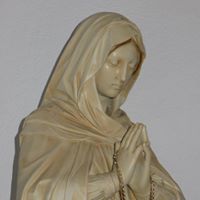 Who is this who comes forth like the dawn, as beautiful as the moon, as resplendent as the sun,
as awe-inspiring as bannered troops? (SS 6:10)
Saint Francis de Sales calls Mary our “captainess” in the battle for virtue and against the world, the flesh, and our own self-will. In his sermon of September 10, 1620, Saint Francis sketches Mary’s credentials for assuming her leadership role: first, the eminent graces given to her as Mother of God ( conceived without sin and with the use of reason); second, her experience in all the states and stages of the spiritual life; and third, her imitable example for we who are still struggling here below.
“In the beginning of her life,” St. Francis preaches, “she was subject to her mother. She remained with her family to show girls and children the honor and subjection they owe their parents… Then she married, to be a mirror for the married, and finally a widow. Thus Divine Providence let her pass through all the states of life in order that all creatures might find in her, as in a sea of grace, what they need in order to form and adapt themselves to their state in life.” To teach us to battle against the world (honors, dignity, fame), Mary enters life a baby and it is in the cradle that she makes this first renunciation of the world. “Come close to her cradle,” Francis invitees us, “think of the virtues of this holy infant… Question the angels, the cherubim and seraphim, ask them if they are equal in perfection to this little girl, and they will tell you that she infinitely surpasses them.” Amid the praises of angels, Mary abases herself, and appears as any other child though in light of her divine favors, she was unlike any other child. No one suspected her gifts and graces. Such was her total renunciation of the world.
Our second enemy is the flesh “which we carry about with us always, and whether we drink, eat or sleep, this flesh always accompanies us and tries to deceive us… and so the continual renunciation of it is certainly most difficult.” Again, it was from infancy that Mary made this renunciation, for like all babies, she must follow the regimen of her mother, and she did this voluntarily – for, as Saint Francis tells us, she certainly had the gift of reason.
The third, and most difficult battle is against our self-will. “We can sometimes reach the perfection of the other two but where there is question of leaving oneself, that is to say, our own spirit, our own soul, our own judgment – even the good things which seem to us better than what has been ordered us, in order to subject ourselves in everything to the guidance of another, here is where there is a question of giving up something that is good…” This death to self, the ultimate goal of religious life, and intrinsic to allowing Christ to live in us by substituting his will for ours, is a life-long process. For Mary, the process was life-long and full of victories. From the time of her nativity, in every circumstance, Mary never used her liberty to oppose the will of God. “Consider well the whole course of her life and you will see nothing but continual subjection. She went to the Temple, but it was her parents who brought her there… Shortly after, they gave her in marriage. See her leaving Nazareth to go to Bethlehem, her flight into Egypt, her return to Nazareth. In short, you will only see in all her comings and goings only an admirable subjection and docility. She went so far as to see her Son and her God die on the wood of the Cross, remaining firm and standing at the foot of it, submitting herself to the Divine decree by adhering to the will of the Eternal Father. Not by compulsion, but of her own free will…” Standing beneath the Cross with holy Mary, may we, too, learn to choose God’s will over our own.
Leonie Martin and the Art of Spiritual Composting
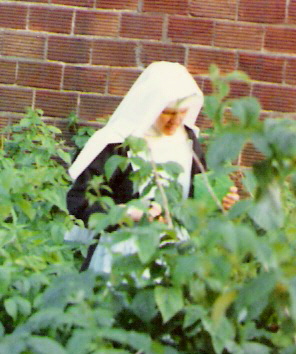
Composting makes good soil which bears good fruit. The benefits of composting, saving kitchen scraps to enrich garden soil, has been proven, but can we say the same for spiritual composting? For Leonie Martin, the practice was a necessity because, in her life and within herself, there were heaps of spiritual garbage.
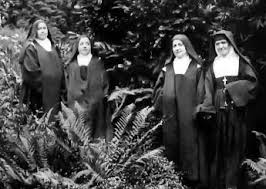
Leonie’s first step in becoming “good soil” for her spiritual garden was admitting her weaknesses, apologizing for her faults, and placing her hurts into a little bucket of humility to bury them in the heart of Jesus. The “mysterious soil” of the forgiving and compassionate heart of her Savior meant confidence in his unconditional love and trust in his mercy. She writes: “I don’t cover up the difficulties, knowing from experience how weak, cowardly and inconsistent I am.” (1919) Faced with her shortcomings, she turns to God’s unfailing love. She does not give up and tries to improve: “I must turn away from my inclinations which lead me to flee from sacrifice and suffering.” (1918) “I have the presentiment that all of these agonies are a purification, and that God, happily, is doing his work.” (1917) This “spiritual composting” was well underway for her when God gave her the unheard of opportunity (she was a cloistered nun) to converse intimately with her Carmelite sisters about their youngest sister Therese’s holy life, holy death, and her “Little Way“. This happened in 1915 when Leonie was called to give her testimony at the canonization process taking place in the Carmel of Lisieux where her three surviving sisters lived.
Now, Leonie, even more determined to continue her work at transformation, was going to: “to hold onto the hand of Jesus and let herself be carried by him”. This second step of Christian composting will become continuous as she surrenders her entire being to merciful love. Leonie made a definitive decision to trust Jesus always and everywhere, to depend upon his will for her life. No looking back. No holding back. It was going to be a lifelong trust walk. Walking with him through the cloisters she would say: “My Jesus and my all! Merciful Jesus, help me!” And as she walks with him, she listens to his voice and is determined to do whatever he tells her: not only does she follow his inspirations, but also the wishes of her superiors: “I count on obedience which truly works wonders in me to the point sometimes that I no longer recognize myself. Also, I love this virtue… because it leads me surely to humility which is my favorite virtue.” (1911) Leonie, the girl whose tantrums would “make scholars forget their Latin“, is now noted for her submission. She asks permission for everything. And this she does, despite her repugnance. Carried in Jesus’ arms does not exempt Leonie from doing her part: “...it seems to me that for me, this is a martyrdom of pinpricks; but in return, it amounts to so many flowers that I cast under the feet of the Infant Jesus.“
This interior transformation, like the mystery of chemical decomposition that takes place underground, remains hidden and silent. It is a time of prayer. A time of doing the most menial tasks in the monastery. A time of struggle which begins to bear fruit: “To go ceaselessly against one’s inclinations, that is the secret of happiness, a foretaste of Heaven, and it puts so much peace into my soul.” Leonie becomes holy not only by holding Jesus’ hand, but by climbing up onto the cross with him to suffer. She accepts merciful love, she abides in merciful love, and – in this third and final step of spiritual composting – she becomes a participant in merciful love. This she does by offering up her own suffering to join Christ’s and by her little works of mercy. As she often said: “Ask of me anything you wish, I am ready to come to your aid.”
Leonie begins to bear good fruit as she herself now becomes the seed that dies and resurrects to new life. Her Good Friday comes. The last ten years of her life bring more physical sufferings: in-grown toenails, knee surgery, illnesses that confine her to bed, arthritis… Yet through it all, she finds joy: “I am getting along marvelously, as my lumbago makes me bend over like a little old lady of a hundred; we go on this way joyously to Paradise..” (1936)
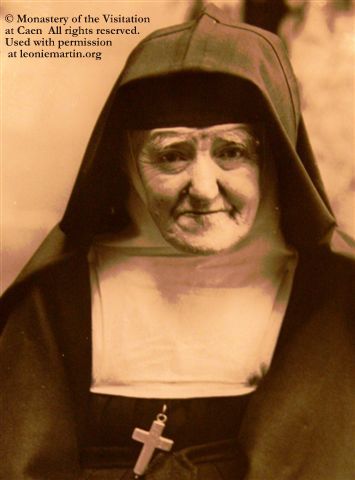
Paradise. She has given all to her Jesus. Followed him through all the doubts and difficulties. She has become good soil. And so, on June 17, 1941, at the age of seventy-eight, her Father in Heaven calls her back to himself. One more time Jesus holds onto her hand: “Come beloved of my Father…”
One can imagine the spiritual garden of Leonie Martin on that day. Early in the morning, with the sun glistening through the dew on the broad leaves of her squash plants – and the soft, damp earth all ’round – covered with hundreds of earthworms dancing with delight. She has arrived.