Ransoming the Captives: Lent with St Francis de Sales
“Can the prey be taken from the mighty, or the captives of a tyrant be rescued? But says the Lord: ‘Even the captives of the mighty shall be taken, and the prey of the tyrant be rescued; for I will contend with those who contend with you, and I will save your children.’” (Isaiah 49: 24, 25)
On January 6, 2001, Pope Saint John Paul II promulgated his encyclical Novo Millennio Ineunte in which he wrote, “We do not know what the new millennium has in store for us, but we are certain that it is safe in the hands of Christ, the ‘King of kings and Lord of lords.'” (NMI #35) Nine months later, on September 11, 2001, the World Trade Center in New York City collapsed.
How are we to ransom these captives: the prey of terrorists, the unborn child, those who are victims of abuse or addictions, those taken captive by the tyranny of relativism – our children? At the dawn of the new millennium, fully aware of the dangers of the “culture of death”, Pope Saint John Paul II called Christians of the world to their knees: “Yes, dear brothers and sisters, our Christian communities must become genuine ‘schools’ of prayer, where the meeting with Christ is expressed not just in imploring help, but also in thanksgiving, praise, adoration, contemplation. listening and ardent devotion until the heart truly ‘falls in love’.” (NMI #33) “God… invites us to invest all our resources of intelligence and energy in serving the cause of the Kingdom. But it is fatal to forget that ‘without Christ we can do nothing.’ (cf. Jn. 15: 5)” (NMI #38)
Robert Cardinal Sarah echoes the clarion call of John Paul II in his deeply insightful reflections in his book, The Power of Silence, when he states: “Christ alone can give man the strength to confront evil and come to terms with it… ‘Apart from me you can do nothing.’ (Jn. 15:5) By the strength of his Cross, he has the power to save mankind…” (#282) “Confronted with evil, man gets organized by gathering the means necessary for his defense… his greatest defense is humble faith and profound prayer.” (#286)
On our knees, in the depths of relationship with Christ, in a “genuine dialogue of love” – this is the beginning, the middle and the end of the battle for our children’s souls. Yet, the pope says, “we well know that prayer cannot be taken for granted. We have to learn to pray, as it were learning this art ever anew from the lips of the Divine Master himself...” (NMI #32) To help us learn this art, we have another saint, from a former time and another place: Saint Francis de Sales.
At the turn of the seventeenth century, Francis de Sales not only used all his resources of intelligence and energy in serving the cause of the Kingdom as a young missionary priest in the Chablais, but also, as Bishop of Geneva, he completed the homework assignment Pope Saint John Paul II gave us for the dawn of the twenty-first century, by making his entire diocese a school of prayer. He handed in his “homework” four centuries early by weaving the fabric of prayer into every aspect of his episcopacy: into his own daily routine of liturgy, sacramental life, and meditation – including the recitation of the complete rosary; by reforming monasteries that had become lax; by establishing the Oratory of Our Lady of Compassion at Thonon as a trade school and seminary; by founding the Florimontaine Academy and the Confraternity of Christian Doctrine in Annecy; by writing thousands of letters of spiritual direction to individuals who wished to become devout Christians; by authoring the spiritual classics, Introduction to the Devout Life and Treatise on the Love of God; and finally, by co-founding with Saint Jane de Chantal, monasteries of the Visitation of Holy Mary, to “give to God daughters of prayer“.
St. Francis tells us that in prayer we occupy ourselves with God in love, great faith, and trust. In prayer we remember that God’s heart is very large and generous and ours is only very small, yet as we draw near to him and his heart, a bonding takes place. In Book VII, Chapter I of his Treatise on the Love of God, Francis, who was the eldest son of a large family, uses the metaphor of a nursing baby to describe this relationship of bonding. How often and attentively he must have regarded his young mother’s attentions to his new baby brothers and sisters! He saw the infant, pressed to his mother’s breast, nursing with delight, seeking to cuddle ever closer to this world that was his mother: a world of warmth, of affection and, of survival. This is Francis’ elusive yet effective image of prayer. In prayer, we desire to unite ever closer to the source of our being and, in turn, God presses us ever closer to his heart.
In the Introduction to the Devout Life, addressed primarily to lay people, Francis takes his students step-by-step through the various kinds and degrees of prayer. He does not want them to get lost along the way in daydreams or discouragement. Always he emphasizes that our prayer must enhance our charity, our sense of duty, and our desire to please God and not ourselves. Here it is that he defines and explains how to say vocal prayers and meditate and contemplate… But Lent is fast approaching and we may not have the leisure to study long at his school. Still, we have captives to ransom and preys to rescue – so we turn to St. Francis to help us.
Not only is Lent coming, but with Lent comes fasting. Jesus told us that some kind of demons are cast out only by prayer and fasting. So let us listen to a word of Francis on this subject. In his sermon for Ash Wednesday, February 9, 1622, St. Francis preaches: “Fasting fortifies the spirit, mortifies the flesh and its sensuality and raises the spirit to God… it disposes the heart to seek to please God alone and with great purity of heart.” He then asks us to fast wholeheartedly, but unostentatiously -just for God. This kind of fasting helps us to pray well. In his book, The Power of Silence, Robert Cardinal Sarah explains, “Asceticism is a means that helps us to remove from our life anything that weighs it down, on other words, whatever hampers our spiritual life, and therefore, is an obstacle to prayer.” (#268) Francis gives us the details: “…not only must we make the bodily senses fast, but also the soul’s powers and passions – yes, even the understanding, the memory, and the will… In short, we ought to hold in check all those things which keep us from loving or tending to the Sovereign Good. In this way interior fasting accompanies exterior fasting.” We have to ask ourselves, what am I willing to give up outside myself, or to silence within myself, in order to make this Lent a time of prayer? To quietly do battle to save an innocent life or to restore innocence to one who has lost it along the way?
Do we believe in miracles? We are praying for moral miracles. Do we have the faith to expect them? In his Lenten sermon of February 17, 1622, Francis de Sales gives us an example found in the Gospel story of the Syrophoenician woman, who, upon hearing that Jesus is staying in her neighborhood, encounters Jesus and intercedes for her little daughter who is possessed by an impure spirit. In his homily, Francis tells us her secrets of success. This Gentile woman, who knows very little of prayer, knows how to love; and out of love comes her lively faith and ardent prayer. Having heard of Jesus’ power, she boldly crosses the threshold of the home where Jesus is staying; and, disregarding Jewish observances, throws herself at his feet and begs him to cast out the demon from her child. Instead of casting out the demon, he tosses her an insult: “Let the children be fed first, for it is not fair to take the children’s bread and throw it to the dogs.” Undaunted, she catches the slight, humbles herself the more, and tosses back an alternative as she begs to be, if not a child of the Covenant, at least its little pet puppy. “Sir,” she counters, “even the little dogs under the table eat the children’s crumbs.” (Mk. 7: 24 -30) At this remark, Jesus is won over, concedes the match, throws in the towel, and immediately casts out the child’s demon.
St. Francis points out four virtues that accompany this woman’s simple prayer: trust, perseverance, patience, and humility. “What great trust!” he marvels. “She believes that if the Lord has pity on her, her daughter will be cured. She doubts neither his power nor his will, for she cries out only, ‘Have pity on me!’ …Certainly the greatest defect that we have in our prayers… is our lack of trust.”
As for perseverance, Francis notes: “We grow weary of praying… The Canaanite woman did not act in this way. For although she saw that our Lord was paying no attention to her prayer, since He gave her no word of response and seemed in this to do her an injustice, nevertheless, this woman persevered in crying out after him… Let us persevere in prayer at all times. For if our Lord seems not to hear us, it is not because He wants to refuse us. Rather, his purpose is to compel us to cry out louder and to make us more conscious of the greatness of his mercy.“
Next is patience. “When this woman heard our Lord (who, we recall, had just referred to her as a dog) she did not lose patience at all. Neither was she offended nor saddened. Prostrating herself at his feet, she replied, ‘It’s true. I am a dog. I admit it. But I take you at your word, for the dogs follow their masters and feed on the crumbs that fall under their table.’
“This humility was the fourth virtue that accompanied the faith and prayer of the Canaanite woman – a humility so pleasing to the Savior that he granted her all that she asked of him… Certainly all virtues are very dear to God, but the virtue of humility pleases him above all the others, and it seems that he can refuse it nothing.” Instead of resisting the woman and her request, He now finds her irresistible. By becoming utterly pathetic, she arouses his pathos and elicits his mercy. Immediately, her daughter is released from her captivity.
Do we believe in miracles? Do we have the love, the trust, and the stamina to keep praying intensely even when no answer seems to come? Do we have the patience to wait for an answer to our prayers and the humility to accept God’s silence? Perhaps these forty days of Lent will not apparently ransom any captive or rescue any prey, yet we must believe our humble, silent cries will be heard and that his merciful love will provide the answer, in His time and in His way.

Francis de Sales: Bridge over Troubled Waters

If you can’t see Jesus, be Jesus.
In our journey through life, we have an essential choice to make: will we be saints – making our world, our families, our communities havens of love and life – or… will we succumb to the tyranny of the culture of death and relativism? “I have set before you life and death, the blessing and the curse.” It is the same today. Francis de Sales, who lived in times and in a place that for the previous 60 years had rejected its Catholic roots and strove to destroy its culture, insisted that this choice between life and death, between egotism and worldliness; or loving God and each other is the most important choice of our life. As he wrote, “All Christian wisdom lies in making the right choice here.”
What did our saint do to help others over these troubled waters of the seventeenth century when Catholic churches were ravaged and Catholic homes were ransacked? First, he changed his own heart. He lived to the max the only maxim that Jesus told everyone to learn, “Learn from me for I am meek and humble of heart.” Francis, the ardent Savoyard born into an ancient family of fighting nobility, became the meek and humble Francis, the gentleman saint. Sent into the (almost) entirely Calvinist Chablais region as a newly-ordained priest, he waged a spiritual war for their conversion. How? By teaching them the truth, speaking heart-to-heart, and …by charity.
The results? After one year of tireless preaching to all-but-empty churches: one convert. But after four years, he had set up an infrastructure to support the faith-life of 72,000 re-converted Catholics. The entire region – after four years of tireless preaching; rebuilding a few ruined churches; recruiting more missionary priests; organizing pilgrimages, processions, and missions; debating with Calvinist preachers; writing and distributing pamphlets; talking for hours with potential converts; being kind and charitable to all; avoiding wolves, weather and would-be assassins; begging for funds – was (almost) entirely Catholic.
Francis de Sales lived the “Spirituality of Communion” outlined by Saint John Paul II in Novo Millenio Inuente (Art.#43) and Francis’ words and example can guide us to becoming “bridges over troubled waters” for our own twenty-first century. How? First, by changing our own hearts. “Oh God, how I wish that our Savior’s heart will be King of all our hearts!” he exclaimed in one of his many letters of spiritual direction. To love and to be loved without limit. This is the deepest desire of every human being. It is God’s first call to holiness to every person without exception. When love becomes the source of our actions, our heart becomes the place of encounter with the God of love. When we change our own hearts to be meek and humble: welcoming, listening, and without prejudice, then we can be the catalyst for another’s conversion. Conversion comes from the inside, from the heart. This is the only way.
Second, we must become experts in the spirituality of communion. This demands some essential shifts in our thought paradigms. How deeply we must be imbued with the realization that every single person is made in the image and likeness of the Trinitarian God! We are all children of God. How often we have heard this. How seldom, in the crunch of “every-man-for-himself” do we live it! Francis, in his Treatise on the Love of God, Book 10, Chapter 11, tries to let us see the reality from above. He relates the story of Tobias, the adult son of exiled Tobit, who goes to the home of his father’s kinsman Raguel for the first time. Raguel, seeing this young man, rushes to fall upon his neck, weeping with joy and embracing him. How much he resembles his father! Francis then writes: “Hey, true God, Theotimus, when we see a neighbor created in the image and likeness of God, should we not say to one another: do you not see this creature, how much she resembles the Creator? Should we not throw our arms around her neck, embrace her and weep out of love for her? Should we not give her thousands and thousands of blessings?” Hold it! What about so-and-so??? But Francis continues, “for love of her? No, certainly, for we do not know if she is worthy of love or hate in and of herself. And why, then? …for the love of God who has formed her in his image and likeness.” We love our neighbor (and ourselves) for the exact same reason. God made us. In his image. Made in love and for love. We are his children. Brothers and Sisters. All.
The next step towards becoming experts in the spirituality of communion is to probe the depths of the meaning of belonging to the mystical body of Christ. “No man is an island, entire in himself,” John Donne wrote. Each of us is a part of the continent, a piece of the whole. We are not alone, nor are we meant to be alone. Others are a part of me, and I of them. Together we are one person. St. Francis de Sales, speaking to his Visitandines, said, “One of the principal fruits of religious life is this holy union which is formed by charity, a union of such a nature that there is only one heart though made up of many, and only one body though composed of many members. In religious life all are so made one, so that all the religious of one Order are but one single religious.” (Conference 16) He went so far as to say that the only thing that he could not tolerate was to see disunion among the monasteries. In religious life or out of it, we are all one. Realizing our dignity as children of God and the reality of the mystical body of Christ, we can then learn to see what is positive in others. Everyone is a gift for me and I for them. When we can really see this, another Francis (our current pope) says: “Everything depends on the way we look at things, on the lens we use to view them. If we change that lens, reality itself appears different. So how can we begin to ‘read’ reality through the right lens? For us Christians, that lens can only be the good news, beginning with the Good News par excellence: the Gospel of Jesus Christ, Son of God… The Kingdom of God is already present in our midst like a seed that is easily overlooked, yet silently takes root. Those to whom the Holy Spirit grants keen vision can see it blossoming.” (Pope Francis, Message for World Communications Day, Jan. 24, 2017) When we see the strengths of others and appreciate them, there is much room for the work-a-day synergy that accomplishes great things, and also for the spiritual synergy that solves problems in creative dialogue and respectful encounters.
Finally, in this spirituality of communion comes the ability to make room for others, that ability to “bear one another’s burdens”. (Gal. 6:2) This demands listening to those with whom we disagree – without judging – patiently walking with them as a friend, waiting for God to act in their hearts. Instead of being spiritual GPS’s, overly-eager to guide every soul to spiritual maturity by our brilliant directions for their life’s journey, we can have compassionate hearts, non-judgmental, flexible hearts. And we can pray. Didn’t our Savior promise that if we had faith the size of a mustard seed, we could move mountains? Pray, and not worry. Pray and love. As Francis de Sales says, “Flexible hearts do not break.” But some of our hearts are broken. Waiting for children to come back home. Waiting for family rifts to end. Waiting for life to be respected from conception to natural death. Waiting for peace. Waiting for addictions to be overcome. Waiting for his kingdom to reign in others’ hearts as well as in our own.
Francis did not give up in the Chablais. He kept his heart open and this is what he advises us to do: “Keep your heart open wide and, so long as the love of God is your sole desire and his glory your only wish, always live joyously and courageously.” Can we do this for others? For ourselves?
Let’s be brave. Let’s be bridges. Everyone is waiting for us.
Our Lady of the Snow
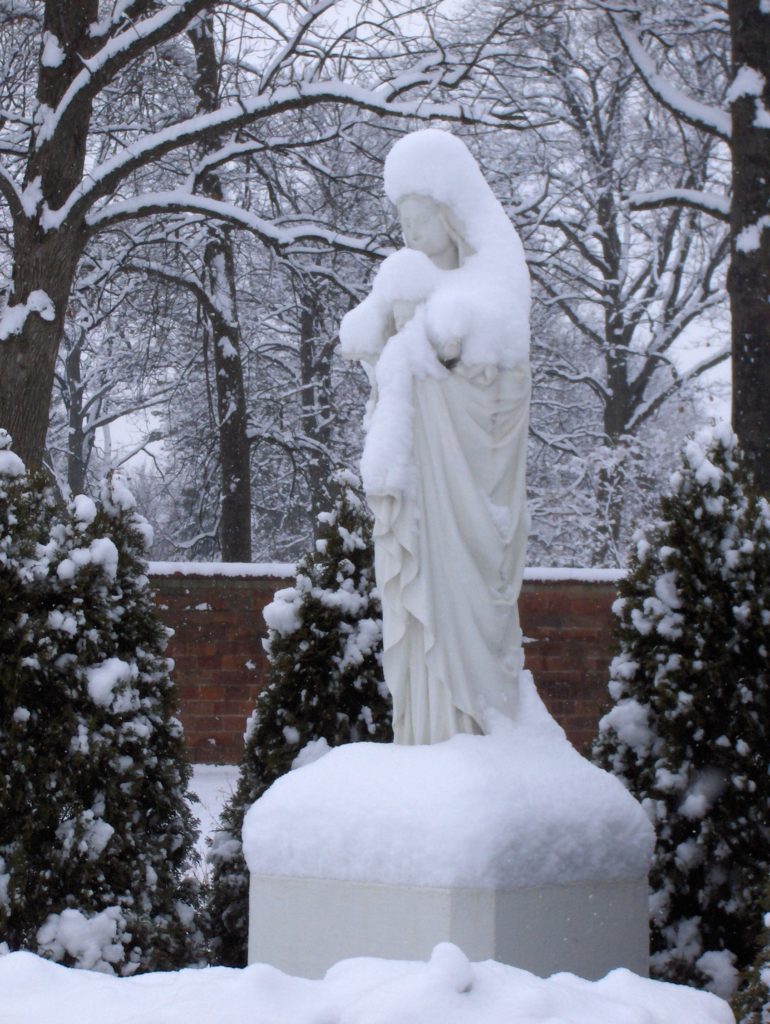
St. Francis de Sales in his homily of August 5, 1617 tells the story of a noble and wealthy, but childless couple who were told in a dream to have a church built on Rome’s Esquiline Hill in honor of the Blessed Mother, erecting it on the spot they would find, in the middle of August, covered with snow. Sharing the dream with Pope Sixtus III (who had had the same dream), the three found the unseasonable snow… and the church, Saint Mary Major was subsequently built there.
The homily was based on St. Francis’ reflections on the reading for the feast’s gospel from Luke 11:27 in which “a woman rose up from the crowd and said, ‘Blessed is the womb that bore you and the breasts that nursed you!’ Jesus replied, ‘Blessed rather are those who hear the word of God and obey it!'” Saint Francis emphasizes that this holy couple like Mary, heard the word and, most importantly, acted upon it. Our saint concludes that effective, active love, is the proof of a true disciple: of his Blessed Mother, of this generous couple of every disciple.
In this season of falling snow, we, too, can be like both Mary and this couple who knew how to listen to the word of god and put it into practice. Like both of them, we can listen to God and respond Look out the window some evening when the snow is falling softly, silently. In the silence of a winter evening, spend a few moments looking and listening to the word of God speaking to you. Watch that silent snow falling from heaven and ask God the question you have been thinking about, or worrying about – your deepest concern… and listen. Then, as St. Francis says (though he was referring to the word in homilies, the same can apply to both), “we ought afterwards to remain for some time withdrawn into the depths of our soul, I mean recollected, in order to ponder what we have heard.” Amid all the noise and haste, amid all the hustle and bustle, become a revolutionary. Stop and listen.
And this is the beginning of prayer. “Oh, what a good thing is prayer!” St. Francis continues, “But the happiness of this holy man (the noble Roman) did not consist in knowing the will of God, but immediately following it, as he did. Oh, how happy are they who, being inspired like this blessed John and his wife to dedicate and consecrate themselves to God with all that they possess, have recourse to prayer to learn in what place they should do it for His greater glory and the honor of our Lady…” Looking at the falling, silent snow. Listening to the word of God in the Bible. Going to church. Do just this during this new year, and become a radical. Radical means “root”and the root of every human being, the core and center of each soul created in the image of God and destined to live forever, is a heart that desires God. Who knows what could happen? Perhaps not another St. Mary Major Basilica, but the church that is within us. The temple of God that we are. Maybe God will ask us to build that temple this new year. Or rebuild it. Still we have to learn to listen…
This brings us back to the snow and to Mary and to St. Francis’ homily. Can we listen for a minute more? St. Francis says that it was not “without significance that snow was the sign of the truth of the revelation made to this good man John and his wife.” Then he points out three qualities of snow: its whiteness, its obedience, and its fecundity. All of these are especially characteristics that draw the special inspirations of God into our hearts. These are also the characteristics of the first and best disciple of Jesus, his mother Mary. And all are characteristics of how we can receive God’s word for our own mission in life and act upon it.
Francis continues, “We may compare the whiteness of snow to the whiteness of a pure soul because it surpasses any other whiteness.” Snow. Mary-full-of-grace. And, yes, even ourselves. “Listen to the royal psalmist David. Lamenting before God that, through sin, his soul has become blacker than black, he entreats Him to be pleased to wash him with His ‘hyssop’ so that by this means it will be made ‘whiter than snow.'” (Psalm 51:9) For anyone, this can mean saying ‘I’m sorry’ to God. For Catholics, it means asking forgiveness of Jesus through his priest in the sacrament of confession. White as snow. Purity. And being more pure, we will be more able to hear the inspirations of God. Not a bad bargain for a few minutes of honesty, humility, and being sorry…
Next, obedience. Snow is obedient! “Ah!” Francis says, “Watch it fall. It falls so gently. See how it remains in the ground until it pleases God to send a ray of sunshine which comes to melt it and make it disappear. Oh, how obedient is the snow!” Mary, the handmaid of the Lord was obedient as she listened to the angel Gabriel’s request and said, “Let it be done unto me…” For us, obedient listening to God includes openness to the word of God in his commandments, but more than that, asks us to follow the words of Jesus of Nazareth in every aspect of our life, such as: “Blessed are the poor in spirit, the meek, the merciful…” Living his message. Listening to his word. Doing it. Obedience. Fulfilling our duties. Doing what we’d rather skip. As St. Francis says, “God makes it very clear that He does not consider that we hear His word if we do not put it into effect with the affection of submission and obedience. Thus does he often complain that His people do not hear Him when He speaks to them.” Submission and obedience. Very radical. Yet this is the complaint we find in God’s Sacred Word: “I was ready to be sought out by those who did not ask, to be found by those who did not seek me.” (Is. 65:1) Are we willing to respond to this word and to become listeners to it?
Finally, fecundity. Fruitfulness. We all search for meaning in life. We all want to make a difference. St. Francis tells us, “In the third place, snow is fruitful. Farmers and those who till the soil assure us that when there is a moderate amount of snow in the winter, the crops of the following year will be all the better for it, since the snow protects the ground from the hard frosts. And although is may seem that snow, given its coldness, cannot warm the ground, it still renders it fruitful for the reason just given – for the grain underneath is well-protected.” Mary, the most fecund woman in the history of the universe, mother of our Lord and of us us all, and the Roman couple, again are exemplars of fruitfulness. Why? Because they listened to God’s plan for their lives. Like them and like silent, freshly-fallen snow, we, too, may listen and then respond with our “yes” in Purity, obedience and fruitfulness.
This winter, be like snow. Like Mary. Like the couple… Listening to God’s voice in the silence…and acting upon it.