The Eyes of Your Heart
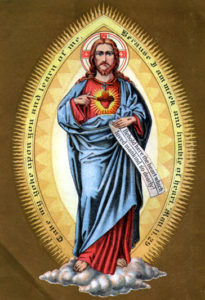
Jesus ascends beyond the clouds, far above suffering and death; ascends to His throne to be seated at the right hand of His Father, forever in glory. “Far above every principality, authority, power, dominion, and every name that is named not only in this age, but also in the one to come.” (Eph. 1:22) If we come to know Him and to abide in Him, the inheritance is ours. No one can imagine this inheritance. Like someone who stumbles into a robbers’ cave, opens his eyes and sees vast treasure chests filled with sparkling gems and gold pieces, the shock is more than our senses can stand. Jesus ascends to His Father to open up the treasure chests of His merits and of graces that are inestimable. “…the fullness of the one who fills all things in every way.” (Eph. 1:23) Riches upon riches. Grace upon grace. The ascension of Jesus brings us to the threshold of His wondrous and endless treasure trove.
Jesus has gone to prepare a place for us. The way is open to us, but we need to open the eyes of our hearts and to trust that our happiness is not to be found on this small planet, on this short river of time, but in eternity. If we direct our gaze upward, the eyes of our heart can receive the riches of grace at each moment. “…Let us approach with a sincere heart and in absolute trust, with our hearts sprinkled clean from an evil conscience and our bodies washed in pure water.” (Heb. 10:22) If we remain true to our confession of faith, our home will be waiting for us. We can look forward to death. We can accept disappointment and disability, transforming them with trust in God’s merciful love to Divine Savings Bonds – to IRA’s that won’t dissolve.
All this is because God our Father has destined us, from before the world began, to be His heirs, blessed us with every spiritual blessing as His adopted children. All this through Jesus Christ, His only-begotten Son. “In Him we have redemption through His blood, the forgiveness of our trespasses, according to the riches of His grace.” (Eph.1:7) Jesus is the greatest all-time “robber”, for He has robbed Death and the Devil of their prey. But how do we gain entrance to this “Robber’s” cave? The opening is very small. For children this is not much of a problem, but for those who are over the age of eight, it can be very difficult to squeeze through because the opening to the cave is none other than the wound left by the lance in Jesus’ heart. You must leave behind all your gear and gizmos, your travel guides, climbing ropes and back packs: there is no room for them. However, once you have entered this cave, this Sacred Heart of Jesus, it is enormous, mammoth, fantastically large. The whole universe could not fill it.
“Beloved,” Pope St. Clement writes to the Corinthians, “Jesus Christ is our salvation…” Treasures that will not tarnish: eternal life, love, laws that lead to true freedom. Treasures that can be given away: wisdom, understanding, counsel, fortitude, knowledge, piety, and fear to the Lord. “Through Him our gaze penetrates the heights of heaven and we see… the most holy face of God.” To love and know we are loved. “Think of the dark tomb out of which our Creator brought us into his world where He had his gifts prepared for us even before we we born…” To exist in this time and in this place. To have a purpose for our life. To be given helps to achieve that purpose. To become who we are, the child of God He created us to be.
With the eyes of our heart, we look up to heaven where Jesus has ascended. He will send the Paraclete with these gifts of life and spiritual rebirth, treasures of grace and love – all born from the blood and water which flowed from the wound in His sacred Heart. And so, entering into the cavern of this heart, this treasure trove of love, we discover all.
Ave Maris Stella: Mary, Star of the Sea

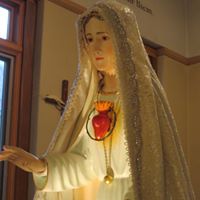
Mary is inextricably a part of God’s plan for the salvation of mankind. She is the Theotokos, the Mother of God, elect daughter of the Father, spouse of the Holy Spirit, and guide of the pilgrim Church. In his encyclical, Redemptoris Mater, Mother of the Redeemer, Pope John Paul II develops the Mariology delineated by the Fathers of Vatican II: “She, like the Church, is both spouse and mother. The Church journeys through time toward the consummation of the ages to meet the Lord who comes. But on this journey… she (the Church) proceeds along the path already trodden by the Virgin Mary, who advanced in her pilgrimage of faith, and loyally persevered in her union with her Son unto the Cross.’ (LG #58)” (RM #1) With Mary’s consent, the promises to Abraham and to David were fulfilled in the incarnation of the Word, who “became flesh and dwelt among us.” (Jn.1:33) Any authentic Marian spirituality recognizes and embraces these Trinitarian, Christological, and Ecclesial dimensions. Likewise, every authentic Marian doctrine comes to life in authentic devotion. At the beginning of Pope John Paul II’s pontificate he dedicated both his being and his mission as pope to Mary. His motto, “Totus Tuus” -“ I am entirely yours!” – was preached in all his weekday audiences, encyclicals, and travels. It was lived every day to the end, even when, close to death and, post-tracheotomy, discovering himself without a voice, he scratched in pen as his response to this sad finale of his pontificate: “What have they done to me?! But…Totus Tuus!“
” Our Theotokos, united with the Church is already the eschatological fulfillment of the Church” (Lumen Gentium, LG#65) Mary has completed the long pilgrimage of faith that began at the annunciation and reached its climax at the foot of the Cross. She is the model of all virtues, the sinless maiden, the Mother of Jesus, the Church, and all humankind. She now looks down upon us with love and tenderness, intercedes for us, and beckons us to follow her Son. In short, she is our Mother. She is our guiding star for our journey through this “vale of tears”. Do we not need this Mother? What is our hearts’ response to her?
We can ignore her. As St. Francis de Sales preached in his homily for the Annunciation, March 25, 1621: “The human heart is a singer infinitely loved by God… But this singer is changeable and more inconstant and fickle than can be expressed… this human heart allows itself to be carried away by its fancies and goes from creature to creature, from house to house, to see if it cannot find someone who will receive it and give it perfect satisfaction. But in vain…” Far from gazing on Mary, the Star of the Sea, we can steer our boat toward our own false or limited loves, freedom, fulfillment, success, wealth, power, or honor – listening to the enchanting music of these mythical Sirens who beckon us to shipwreck on unseen shoals. “Worldly advantages, houses, gold and silver, riches, even honors, dignities, which our ambition makes us seek so madly – are we not foolish to fix our hearts on them?” St. Francis exhorts. “Instead of giving true repose and tranquility, they cause eagerness and great anxiety, to preserve or increase them if we have them, or to acquire them if we do not possess them.” Yet, if we do not go to Mary, as our mother, she is patient and still waits for us with wistful longing.
We can refer to her and defer to her, more or less, like a pocket guide, when and where we choose. At set times and places when the sea is calm, or when storm clouds threaten and the seas get choppy. A rosary, an invocation, a novena. All these devotions and regimens are pleasing to our humble mother, but it is our heart that she most desires.
And yes, we can choose to give her our heart. We can then fix our gaze on her at all times We can hold her hand on this pilgrimage of life, entrusting our very lives to her. This is the devotion that St. Louis de Montfort preached and proposed in his book, True Devotion to Mary. This is the devotion that Pope Saint John Paul II lived and recommended when he entrusted the third millennium to her Immaculate Heart on October 8, 2000, the day after the Feast of the Holy Rosary. On that day, he addressed Mary as he spoke to the bishops gathered in Rome: “You are the splendor which in no way dims the light of Christ, for you exist in him and through him. Everything in you is fiat; you are the Immaculate One, through you there shines the fullness of grace.” For him, the rosary was much more than a recited prayer, it was reliving the mysteries of Jesus’ life with her, pondering them in her maternal heart. For him, Mary was the incomparable model of contemplating Christ – for her gaze never left his, and his never left hers.
Not only in contemplative prayer, but also in imitation of her virtues do we keep our gaze fixed on this shining star. Because she is the model of all virtues, we should see Mary not only as a single, bright guiding star, but as a cluster of stars. As St. Francis de Sales points out, “…her life was nothing else but a continuous passage from virtue to virtue.” (FdS, Sermon, March 25, 1621) And, according to St. Francis in this same homily, the stars of greatest magnitude in this cluster of eminent virtues are the virtues of purity, humility and charity. Her virginity and purity were unsurpassed in all creation because they were chosen and fruitful. Not only did she conceive Our Lord as a virgin, but she has drawn others to her purity – enrolling young virgins to dedicate themselves entirely to God – as well as those who regain their purity – like Mary Magdalen – to become beautiful and pure once more. Her humility is also unmatched, for at the very moment that she is declared the chosen of God by the Angel Gabriel, she declares herself “the slave of the Lord”. She is ever-ready to serve the Lord, forever following the lead of the Holy Spirit. She thus travels to help her pregnant cousin Elizabeth, journeys to Bethlehem at the command of the governor and gives birth to Jesus there, flees to the faraway land of Egypt at a moment’s notice, follows her Son even to the Cross, and acts as mother to the infant Church. Her humility is one of entire obedience, dedication, and faith. Her charity, too, is unequaled for it was proven by the total gift of herself and by the sacrifice of her only Son. She held nothing back and advises us to do the same: “Do whatever he tells you.” (Jn. 2:5)
With Mary, our Mother, as our guiding star, there is safety and assurance. We can fix our gaze on her and entrust our lives to her unfailing and infallible guidance. We can then bring our little boat safely to port – to heaven.
As St. Bernard of Clairvaux once wrote:
She is that magnificent and extraordinary star; so much needed, set in place by necessity above this vast and spacious sea, resplendent with merits; shining with examples for our imitation. Oh, whosoever thou art that perceiveth thyself to be drifting on the river of this age through violent winds and storms, rather than walking on firm ground, turn not away thy eyes from the splendor of this Star, unless thou wish to be submerged by the storms! When the storms of temptation burst upon thee, when thou see thyself driven upon the rocks of tribulation, look at the star, call upon Mary! When buffeted by billows of pride, or ambition, or hatred, or jealousy, look at the star, call upon Mary! Should anger or avarice, or fleshly desire violently assail the frail vessel of they soul, call upon Mary ! If…thou are beginning to sink into the gulf of sadness and to be swallowed in the abyss of despair, then think of Mary! Let her name not leave they lips, let her not leave they Heart.
Rebuilding Notre Dame …Within Ourselves
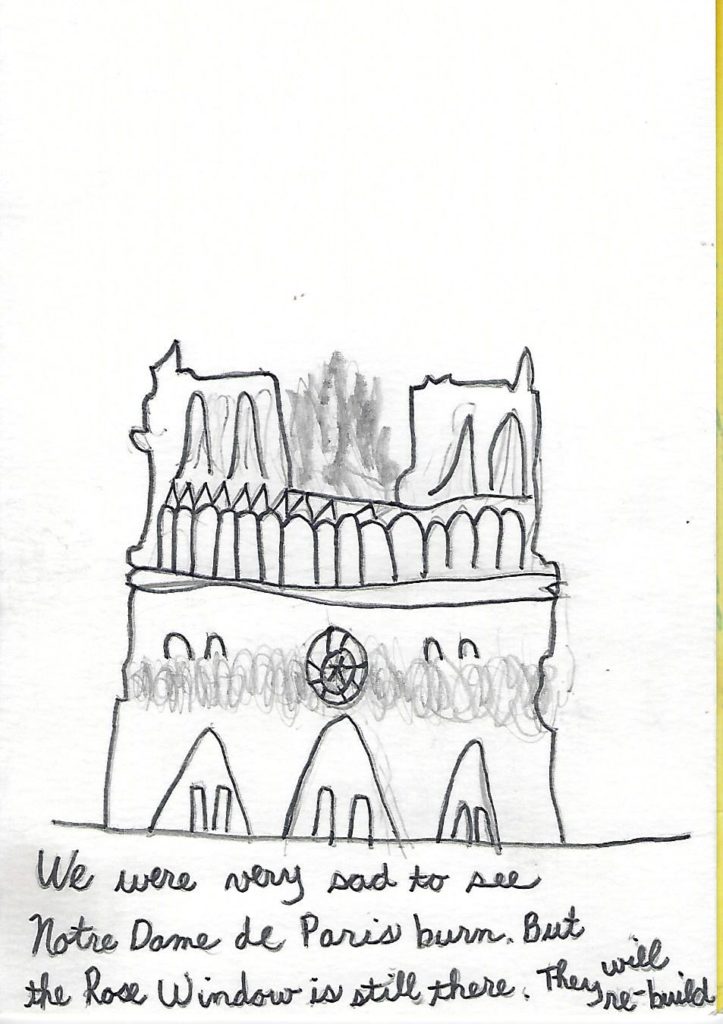
“Wisdom has built her house, she has hewn her seven pillars.” Proverbs 9:1
Perhaps we know someone for whom Notre Dame de Paris signifies a huge cathedral, its roof all ablaze against a mid-April night sky in the year 2019. This person may be, through no fault of their own, one for whom the identity of its namesake, Our Lady, is, is like King Childebert’s and Bishop Germaine’s first Notre Dame de Paris, a forgotten memory of 558 A.D. – established and destroyed before their time. For most of us (except, of course, saints like Pope John Paul II for whom Our Lady was his all, his “Totus Tuus”) Our Lady’s Month of May can be a time to rebuild devotion to her: either by beginning, like medieval masons, from the foundation; or, like modern-day Parisians, making plans to restore the roof of our entire spiritual edifice.
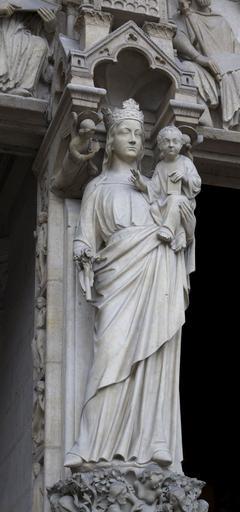
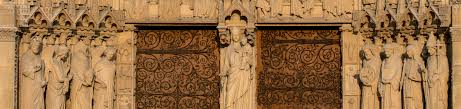
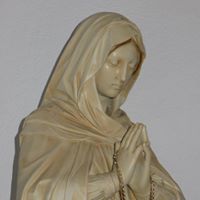
Who is this Lady? If we do not know the Blessed Virgin Mary, Our Lady, we can begin by imagining ourselves a poor French street urchin, un gamin, romping around the western portal of the Blessed Virgin, gazing at all the colorful figures carved in stone like a great picture book, to introduce us to Christ’s mother and ours. Her lovely figure, holding the Christ-Child, stands between two doors, but there, under her feet, we spy…a serpent! What does this mean? Listen to the stones tell you these words from the first book of the Bible: “I will put enmity between you and the woman, between your seed and hers. Her seed will crush your head and you shall lie in wait for her heel.” (Gen. 3:15) God is speaking to our first parents, Adam and Eve. They ate the forbidden fruit from the tree of life. They are punished by God for disobeying his command and kicked out of the beautiful garden. They must now work by the sweat of their brow, die, and – for women – have pain when they give birth to their children. But, God is love and mercy. He promises to send a woman who will give birth to a Savior. That woman’s name? Mary. Our Lady. And her Son? Jesus. God’s Son and hers. And the serpent? The devil. Jesus will be born of the Immaculate Virgin Mary and will crush the head of the devil by dying on the Cross. Jesus saves.
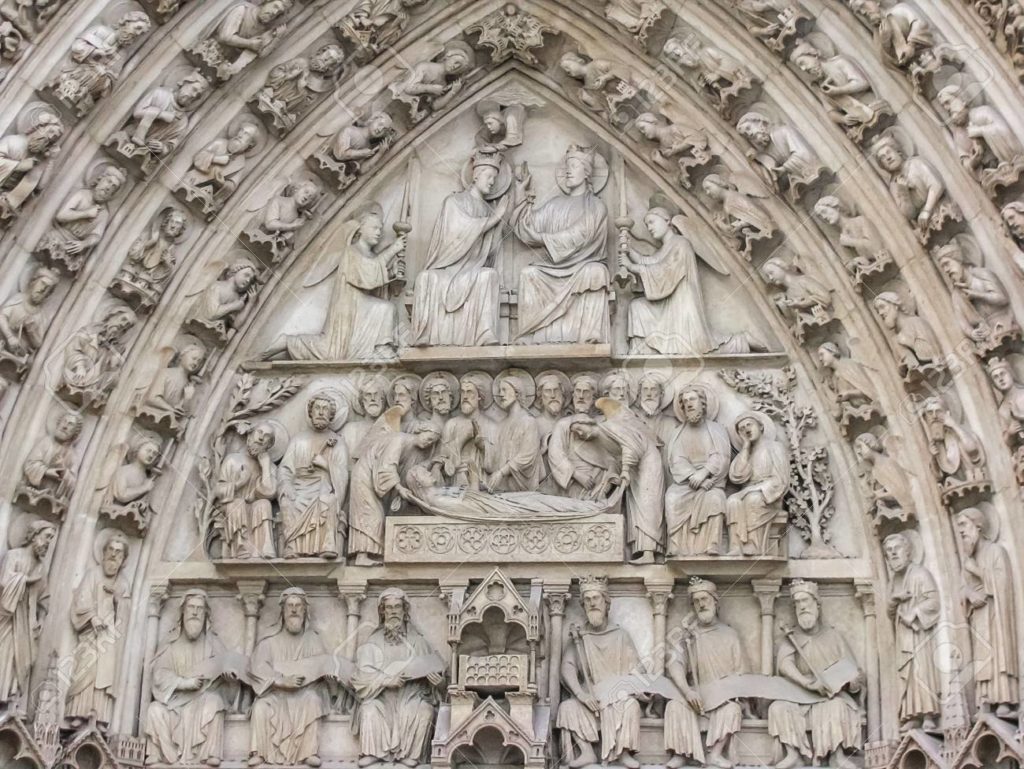
Above the head of the Virgin, we look up to see three wonderful scenes that continue this true story. In the scene just over her head are some men who lived hundreds of years before her birth and foretold her coming: her noble ancestors, three kings; and three prophets. Listen to one king, Solomon, speak to us about Mary: “Who shall find a valiant woman?” Or again, listen to the Prophet Isaiah: “Behold, a virgin shall conceive and bear a Son and his name shall be Emmanuel.” (Is. 7:14) Or the Prophet Jeremiah saying: “The Lord hath created a new thing upon the earth, a woman shall encompass a man.” (Jer. 31:22) These figures carved in stone on this 800 year old cathedral – the kings wearing crowns and the prophets holding their scrolls – are teaching us that God’s promises are fulfilled in Mary, the virgin mother of Jesus. It was she, born of the noble house of King David, who said “Yes” to the Angel Gabriel when he appeared to her and asked her, whom he called “Full of Grace“, to become pregnant by the power of the Holy Spirit and to “encompass” the God-man by becoming his Virgin Mother. She was the valiant woman who gave birth to Jesus, Emmanuel or God-with-us, in a stable in Bethlehem, and she who stood by him throughout his entire life and most heroically, at his death on the Cross.
The second level above Mary’s statue has a scene portraying what is known as Our Lady’s “dormition” and her assumption into heaven. Some years after the death, resurrection, and ascension of Jesus into heaven, Mary died. But God did not allow her body to decay. Instead she was “assumed” into heaven. This second scene shows the Blessed Virgin Mary laid out on a sheet, surrounded by the apostles or friends of Jesus, as two angels, one at her feet, and one at her head, lift her up into heaven.
The third and uppermost level above the Virgin’s statue has sculptures illustrating another scene in this story of Mary’s life. Here we find Our Lady seated next to her Son, Jesus, on a throne. Jesus is handing her a scepter as an angel puts a crown on her head. She reigns now with Him as Queen of Heaven.
But Our Lady is not only the Mother of God and Queen of Heaven, she is our mother, too. This happened when Jesus spoke to her and his best friend, John, when he was dying on the Cross. He said to his mother, “Woman, behold your son.” And to John, he said, “Behold your mother.” (Jn. 19:26-27) What Jesus meant was that from then on, we, all of us, are her children; and, she is our mother. This means that she will always help us. Always. We see Our Lady’s children carved in stone on the legs of both doors. All around her are people doing all the things people do. It shows the work of each season in the immutable life of men. They live, they work, they die. Mary is right in the midst of them. She is their mother. She is their helper. She watches over them throughout their entire life and especially at their death. If you never learned the story of Our Lady before, now you know. A cathedral named after her, Notre Dame de Paris, has been waiting 800 years to tell you that story. It was built to give honor to her, Our Lady, Mother of God and our mother, too. We can honor her with a short prayer called the “Hail Mary”. We can say it every day of our life, whether we have known about Mary all of our lives or whether we have just become familiar with her. Here is how it goes: “Hail Mary, full of grace, the Lord is with you. Blessed are you among women and blessed is the fruit of your womb, Jesus. Holy Mary, Mother of God, pray for us sinners now, and at the hour of our death. Amen.”